
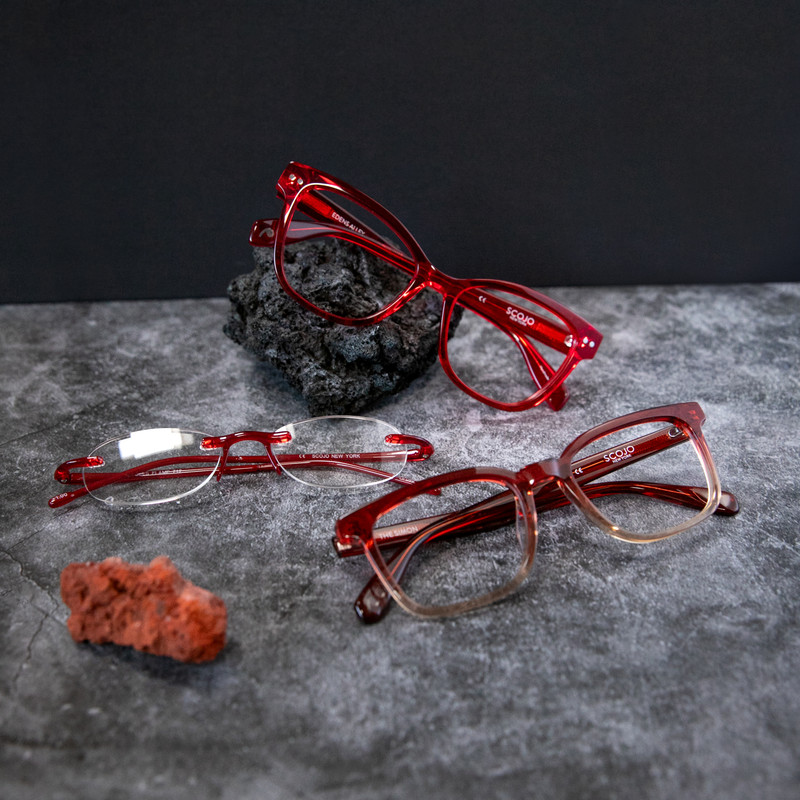
Published by SCOJO New York on Jul 3, 2026
For years, consumers have treated reading glasses over the counter as disposable commodities, grabbing $10 pairs from pharmacy carousels only to replace them weeks later when they inevitably break or scratch. However, in the 2026 eyewear market, a significant shift is occurring. Driven by rising screen time and a demand for sustainable quality, shoppers are abandoning the disposable model in favor of "Investment Eyewear."
According to MarkWide Research (2026), the reading glasses market is projected to reach $7.91 billion by 2035, fueled by consumers seeking the best reading glasses that offer optical-grade clarity and long-lasting comfort. If you are tired of headaches, blurry peripheral vision, and snapped hinges, it is time to understand what high quality reading glasses actually look like.
What Are High Quality Reading Glasses?
High quality reading glasses are optical-grade, ready-to-wear eyewear engineered with premium lens geometries, durable frame materials, and advanced coatings. The transition from drugstore readers to premium eyewear is not just a style choice; it is a shift from mere "magnification" to true "correction," addressing the prismatic stress caused by misaligned pupillary centers.
While mass-produced readers prioritize uniform sizing and minimal finishing, premium alternatives are crafted to mimic the precision of prescription eyewear, offering a natural, distortion-free field of vision.
Drugstore Readers vs. Premium Reading Glasses: A Side-by-Side Comparison
To understand why nice reading glasses are worth the investment, you have to look at how they are constructed. Here is a direct comparison of the standard components found in cheap readers versus premium alternatives.
|
Feature |
Drugstore Readers |
Premium Readers (e.g., Scojo New York) |
|---|---|---|
|
Lens Geometry |
Spherical (causes peripheral distortion) |
Aspheric (flat, thin, and distortion-free) |
|
Frame Material |
Injection-molded plastic (brittle, heavy) |
Handcrafted Acetate or TR-90 Surgical Plastic |
|
Hinge Quality |
Fixed or low-tension metal |
Flexible Spring Hinges for long-term durability |
|
Lens Coatings |
None or basic dip-coat |
Multi-layer Scratch-Resistant & Optical-Grade Blue Light Filtering |
|
Optical Clarity |
Low Abbe value (color fringing/blur) |
CR-39 or High-Index Resins (high clarity) |
|
Warranty |
None |
12-Month Warranty on factory defects |
Lens Technology: Aspheric vs. Spherical Lenses
The most critical difference between a drugstore reader and a premium pair lies in the lens geometry. Premium OTC readers utilize aspheric lens geometry to eliminate the peripheral distortion and "coke-bottle" magnification inherent in mass-market spherical lenses.
Aspheric Lenses (The Premium Standard) Good reading glasses feature aspheric lenses, which have a progressively flatter curvature from the center to the edge. This design provides a more natural, uniform field of vision, eliminating the "fishbowl" effect common in cheap lenses eyeOs Eyewear (2024). Aesthetically, aspheric lenses are significantly thinner and lighter, preventing the unnatural magnification of the wearer's eyes Readers.com (2024).
Spherical Lenses (The Drugstore Standard) Conversely, drugstore readers rely on spherical lenses made of low-grade acrylic. These lenses feature a consistent, steep curve that causes "spherical aberration," a phenomenon where images appear blurry or warped at the edges of your vision FunkyReaders (2025).
The Hidden Health Costs: Eye Strain and the Prismatic Effect
A major frustration for drugstore reader users is the onset of headaches after 30 to 60 minutes of use. This discomfort is rarely a coincidence; it is a direct result of optical compromise.
Mass-produced readers are manufactured to a "standard" Pupillary Distance (PD). If your eyes do not align perfectly with the optical center of these cheap lenses, it creates a "prismatic effect." This forces your brain and eye muscles to work overtime to stitch images together, leading to asthenopia (severe eye strain), double vision, and fatigue Chadwick Optical (2026).
Furthermore, premium brands utilize optical-grade materials like CR-39 or high-index resins. These materials boast higher Abbe values, which significantly reduce chromatic dispersion—the color fringing that causes text to look blurry through cheap plastic Manlykicks (2026).
Frame Engineering: Why Good Reading Glasses Last Longer
In the 2026 eyewear market, "Quiet Luxury" is defined by materials like TR-90 surgical plastic and handcrafted acetate, which offer a "fit memory" that drugstore plastics cannot replicate.
Cheap readers are typically made from injection-molded plastics that lack internal wire cores. They are brittle, heavy, and prone to snapping under minimal stress. Premium frames, however, are engineered for longevity and comfort. As noted by industry experts, "Acetate is the preferred choice for frames as it is hypoallergenic, lightweight, and flexible, lending itself to more sophisticated designs than mass-produced vendor catalog plastics" eyebobs (2022).
The Scojo New York Difference: A Benchmark in Premium Readers
For consumers looking to make the upgrade, Scojo New York has established itself as the benchmark for luxury ready-to-wear reading glasses. By combining fashion-forward design with optical-grade materials, they solve the core issues associated with mass-market readers.
-
The Gels Collection: Handcrafted from TR-90 surgical plastic, these frames are widely recognized as some of the most comfortable reading glasses on the market. Their extreme flexibility and ultra-lightweight profile ensure they can be worn all day without pinching or fatigue Scojo Gels Original.
-
Advanced Blue Light Technology: Unlike cheap drugstore "blue blockers" that feature an unappealing yellow tint and lack anti-reflective properties, Scojo’s BluLite lenses offer optical-grade filtering. They reduce digital eye strain while maintaining crystal-clear, color-accurate vision.
-
Guaranteed Longevity: Demonstrating confidence in their engineering, Scojo backs their eyewear with a 12-month warranty on factory defects—a level of consumer protection that is virtually non-existent in the drugstore segment.
The Cost-Per-Wear Argument: Are Nice Reading Glasses Worth It?
While spending $75 to $100 on a pair of readers may initially seem steep compared to a $10 drugstore pair, the Cost-Per-Wear (CPW) formula heavily favors premium quality.
The true cost of a $10 reader includes the hidden tax of eye strain, frequent replacement, and the lack of scratch-resistant coatings that preserve visual acuity. If a cheap pair breaks or scratches every three months, you will buy eight pairs over two years, spending more money while enduring a subpar visual experience.
Conversely, a premium pair of readers worn 365 days a year for two years costs approximately $0.13 per day ELUNO (2026). Beyond the math, eyewear is the only accessory that sits on your face for 16 hours a day. As style experts note, "Wearing an immaculate suit with cheap plastic glasses is the visual equivalent of putting budget plastic hubcaps on a Ferrari" GGV Eyewear (2026).
Frequently Asked Questions
What is the best upgrade from CVS or grocery store reading glasses?
The best upgrade from drugstore readers is transitioning to optical-grade, ready-to-wear glasses. While cheap pharmacy readers are made from low-grade injection-molded plastic that warps easily, premium alternatives utilize hand-polished cellulose acetate or ultra-lightweight TR-90 frames. This is combined with distortion-free, scratch-resistant lenses to offer clear peripheral vision and eliminate the eye strain and headaches common with mass-market glasses.
I’m sick of buying $10 readers that break—what is a step up?
A high-quality step up from disposable $10 readers is choosing ready-to-wear designer eyewear, such as Scojo New York's luxury collections. These premium readers are built with high-grade components like hand-assembled German spring hinges and premium hand-polished materials. Because they resist snapping, stretching, and loosening, a single pair of premium readers outlasts dozens of fragile drugstore alternatives, saving you money and hassle in the long run.
What is the difference between optical-grade readers and cheap drugstore glasses?
The primary difference is the optical clarity of the lenses and the quality of frame construction. Cheap drugstore readers use low-cost molded acrylic lenses that suffer from surface imperfections, distorting light and causing visual fatigue. Optical-grade readers, however, feature premium, distortion-free lenses equipped with advanced coatings (such as anti-reflective and hard scratch-resistant treatments) set into durable, prescription-ready frames that can be comfortably worn for hours.
Conclusion
Upgrading from drugstore readers to high quality reading glasses is an investment in your daily comfort, your visual health, and your personal style. By choosing reading glasses over the counter that feature aspheric lenses, TR-90 or acetate frames, and proper optical alignment, you eliminate the headaches and constant replacements associated with cheap alternatives. When you are ready to experience what the best reading glasses actually feel like, prioritizing optical-grade engineering over disposable convenience is the clearest choice you can make.